
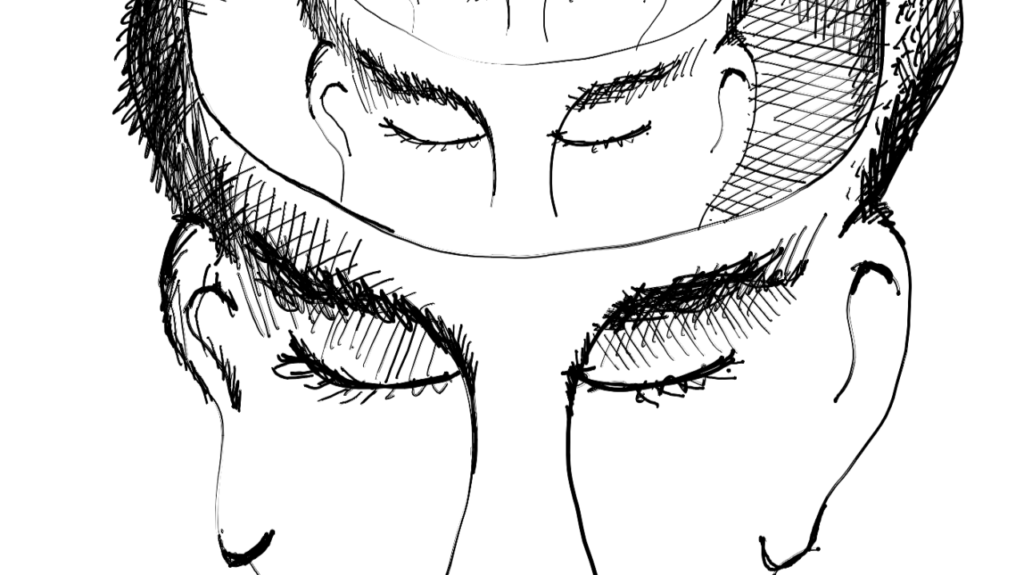
It’s easy to think AIs think. The impression, right or wrong, might be unavoidable for us. Anthropomorphism is a force of nature. Human beings have evolved the cognitive module known as Theory of Mind to help us deal with other conscious beings.
Like other instincts which evolved to help a simpler way of life on the prehistoric savannah, Theory of Mind tends to over-do things in the built environment. It can lead us to falsely intuit that all sorts of things are alive. Anyone remember the Pet Rock craze?
Theory of Mind spawns irresistible psychological illusions, just as our evolved visual cortex leads to optical illusions when faced with unnatural inputs. And so some people go so far as to feel that LLMs are sentient. Some very good thinkers indeed think like this.
The compelling impression that AIs are alive like us leads us to presume they’re doing all sorts of things just like us, such as comprehending and apprehending. But we’re probably reading too much into these ersatz minds.
Consider reading. Surely Large Language Models can read? Their very name suggests that LLMs have a grasp of language. We see them ingest text, interpret it and describe what it means. So that means they’re reading, doesn’t it?
Well, no, AIs don’t even do that. When asked to examine a piece of English and answer structural questions about it–for example, “How many Rs are in the word strawberry?”, LLMs often get it wrong. Check out this short explainer on Instagram by the wonderful former Google software engineer Alberta Devor.
This is more evidence that AIs lack self-awareness. They do not reflect on their answers like we humans do. Large language models have no inner voice that applies common sense to filter right and wrong, much less a conscience to sort good and bad. This makes AIs truly alien creatures, despite their best impressions.
AI failure modes are deeply weird, but society has no institutional mechanisms to deal with them. Our reliability engineering, risk management, forensics and legal practices are all premised on failures being attributable to either human error (which we can trace back to a responsible party) or to random events for which we usually have solid statistics. These time-honoured approaches don’t apply to AIs yet we’re letting them drive on our public roads.
Our mental models of AI are hugely important. We talk about AIs “reading” and “writing”. We see them “seeing”; we interpret their outputs as “interpretations”. But these are all metaphors, and they’re wildly misleading.
Image Copyright © 2026 Stephen Wilson.